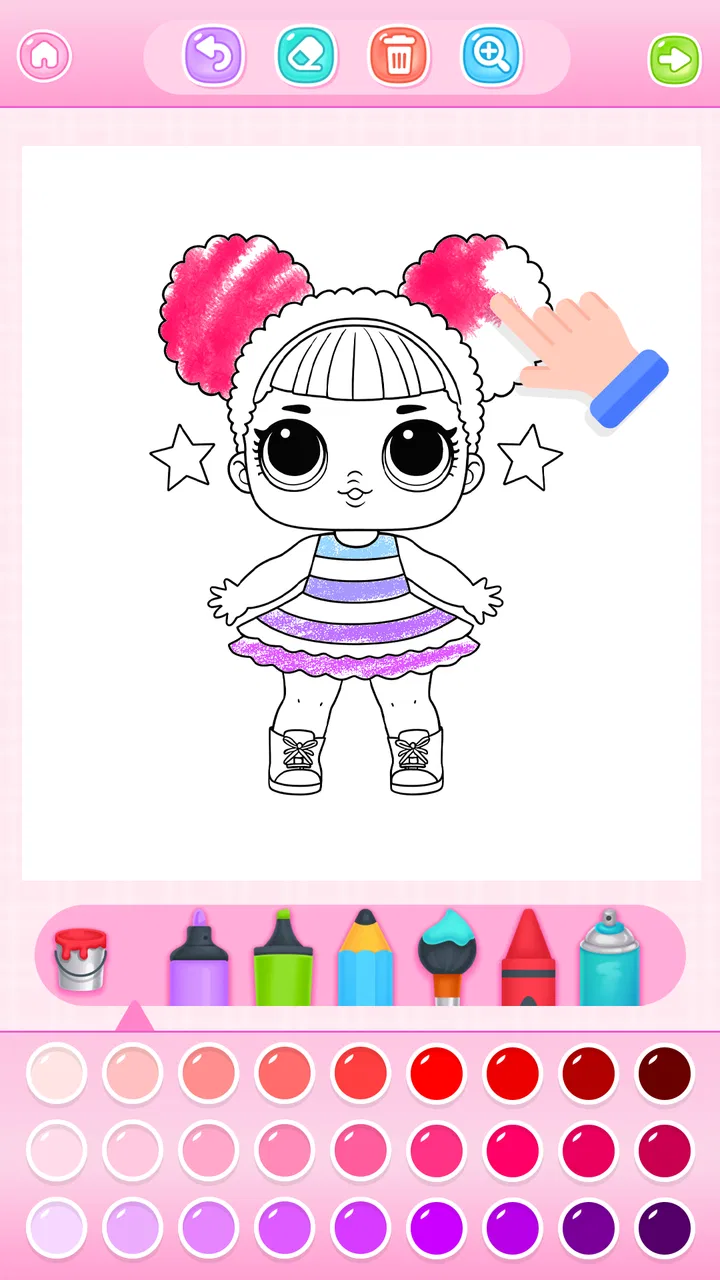
Doll Princess Coloring Games
- 3.8
- Rating
- 100.00K
- Installs
- Free
- Price

 Analysis by App-foxy
I went into Doll Princess Coloring Games expecting a simple children’s coloring activity, and that is exactly where its appeal begins. It is a free educational game from FunKidStudio built around a doll-princess art theme, with coloring and drawing at the center rather than competition or complicated rules. After spending time with it, I see it as a low-pressure option for children who enjoy decorating characters and experimenting with colors, especially when an adult wants a quiet activity that still feels more purposeful than passive video watching.
The important question is not whether the first few drawings are entertaining. They probably will be for the right child. The more useful question is whether this game continues to deserve space on a phone or tablet after the novelty of a princess theme wears off. My answer is fairly balanced: it has a clear place as a casual creative tool, but its long-term value depends heavily on the child’s age, patience, and willingness to make their own goals. It is not the kind of educational game I would install expecting a complete art curriculum.
From an exciting first week to a realistic routine
I find that the most useful way to judge the first stretch is to notice whether a child begins setting their own small goals, rather than simply finishing pictures. That shift can make a short coloring session feel intentional without turning it into a lesson. It also gives me a practical starting point for deciding what could keep the game relevant once the initial excitement settles.
You May Also Like

 Blood Strike: 2.5 Anniversary
Blood Strike’s Loadouts Turn Every Drop Into a Tactical Gamble
A close look at Blood Strike’s custom loadouts: how fast access to signature weapons reshapes its battle royale rhythm, rewards preparation, and narrows the gap between fights.

 Pandora - Music & Podcasts
Pandora’s Music Is Easy to Start, but Harder to Recover
Pandora’s strength is its low-effort path from a seed to a station. Its weak spot is how much confidence it asks you to place in connection, setup, and quiet recovery.

 8 Ball Pool
 Is Built on Rivalries, Rematches, and Routine
A close look at the rivalries, rematches, shared routines, and unanswered safety questions that turn a quick pool match into a persistent mobile community.

 Samsung Music
’s Quiet Strength Is Playing What You Already Own
Its reach comes less from spectacle than from dependable access to a personal library. That simplicity is both the app’s strongest retention engine and its ceiling.

 AccuWeather: Weather Radar
AccuWeather Review: A Quick, Clear Forecast for Everyday Decisions
For everyday plans, the best forecast is the one you can understand quickly. AccuWeather makes rain timing, radar, and local conditions easy to act on, with a few trade-offs.

 Hill Climb Racing
Why Hill Climb Racing Still Turns Crashes Into One More Run
A tiny car, a bumpy hill and one more upgrade: Hill Climb Racing keeps resurfacing because its simple chaos makes every near-miss feel personal.
More From Our News Desk



Why the opening experience works for young players
The strongest part of the experience is how easy it is to understand. A child does not need to learn a long set of instructions before starting. The doll-princess setting gives the activity an immediate identity, while coloring makes the first interaction familiar even for children who have never used a digital art app. That simplicity matters: younger players can begin with little help, and older children can quickly move from filling areas to making more personal choices.
I also like that the game sits between entertainment and practice. Choosing colors, staying within an area, changing a visual decision, and finishing a picture can all support basic hand-eye coordination and creative confidence. Those are modest benefits, but they are realistic ones. I would not describe it as formal art instruction, and parents should not expect lessons in perspective, shading, or color theory. Its educational value comes from repeated hands-on decisions rather than from teaching a structured sequence of concepts.
For a first-week trial, I would introduce it during a short, clearly defined session. A child might color one picture after breakfast, during a quiet afternoon, or while waiting for an appointment. That approach helps reveal whether the game itself is interesting or whether the child is only responding to the newness of a freshly installed app. If the child starts choosing colors with intention and returns to complete pictures without constant prompting, that is a good sign.
A useful everyday scenario
One realistic use is a short after-school wind-down. A child comes home tired, has already had a snack, and wants screen time before homework or dinner. Instead of opening a fast-paced game, a parent can offer this as a calmer creative choice. I would keep the session short and ask the child to explain one choice afterward: why a dress is a certain color, what they would change, or which part was most enjoyable. That small conversation turns a solitary coloring task into a more active creative exercise.
Another practical use is shared play between an adult and a child. Rather than taking over the drawing, I would let the child lead and ask questions such as, “What colors belong in this scene?” or “Can you make the next one look different?” This matters because digital coloring can become repetitive when the player simply taps through areas. Encouraging a reason behind each choice adds imagination without pretending the game offers a deeper teaching system than it does.
What the first week can and cannot prove
The first week is likely to show whether the theme matches the child’s interests. A child who already enjoys dolls, fashion, princess stories, and coloring may find the combination inviting. A child who prefers vehicles, animals, puzzles, or open-ended construction may lose interest quickly, even if the controls are easy. That is not a flaw in the child or the game; it is a matter of fit.
I would also use the first week to check how much adult involvement is needed. Some children can explore independently, while younger users may need help understanding the available choices or deciding what to do next. The Everyone age rating makes the game broadly approachable, but an age label does not guarantee that every child will find the same level of guidance or challenge. Parents should judge the actual experience according to the child’s reading ability, attention span, and comfort with touch controls.
The game is free to start, which makes this trial easier for families. There are in-app purchases ranging from ninety-nine cents to four dollars and ninety-nine cents per item, so I would still set expectations before handing over the device. A child who enjoys collecting or unlocking creative content may become interested in spending, and a parent should decide in advance whether purchases are allowed. The free entry point is helpful, but it does not automatically mean the complete experience will remain cost-free.
What remains valuable after the novelty fades
After the theme feels familiar, I would look for value in the choices a child brings to each picture: a color rule, a character idea, or a story to tell afterward. Those small decisions can turn a repeated activity into a modest creative ritual, while also showing when a child is ready for a wider canvas. The next question is whether that routine remains worthwhile over time.
Recurring value comes from changing the activity, not just repeating it
Coloring games can have a short life if every session follows the same pattern: open a picture, fill spaces, finish, and leave. The way to extend the value here is to give each session a different purpose. One day, a child can focus on warm and cool colors. Another day, they can create a character with a deliberately unusual outfit. A parent can also ask for a “matching set” of colors across several drawings or invite the child to create a story around the finished princess.
That kind of use is one of the more important insights I took from the game. The app supplies the themed activity, but the lasting routine has to come from the player or the adult. If you expect the game to generate a new challenge every time, it may feel thin. If you treat it as a digital sketchbook for small creative prompts, it can stay useful for longer.
I would not use it as the only art app on a child’s device. Its appeal is focused and accessible, while a more open drawing tool may offer greater room for experimentation once a child wants to draw without a preset subject. On the other hand, open drawing apps can feel intimidating to beginners because a blank canvas demands more decisions. This game works better at the starting point, when a child wants structure and a recognizable character rather than complete freedom.
How it compares with familiar alternatives
Compared with paper coloring books, the digital format is cleaner and easier to reset. There is no need for a pencil sharpener, and a child can try a different color choice without throwing away a page. That makes experimentation less intimidating. Paper still has advantages, though: it develops a different physical relationship with tools, does not depend on a screen, and can become a keepsake. For a balanced routine, I would alternate between this game and real crayons or colored pencils instead of treating one as a replacement for the other.
Compared with fast mobile games, the pace here is gentler. There is less pressure to react quickly, win, or manage a complex system. That makes it a better fit for quiet time, but it also means children who need constant challenge may find it unexciting. Compared with educational puzzle games, the learning is less explicit. A puzzle app may offer clearer goals in counting, spelling, memory, or logic, while this title supports creativity and basic interaction more indirectly.
Compared with general drawing software, the princess theme provides a more welcoming starting point but a narrower creative ceiling. I would choose this game for a child who needs encouragement to begin coloring. I would choose a broader drawing app for a child who is already asking to sketch original characters, design scenes, or control brush styles. The best choice depends on whether structure feels helpful or restrictive.
Who is most likely to keep using it?
The strongest audience is children who naturally return to character-based creative play. If a child likes decorating dolls, inventing outfits, or picking colors for storybook figures, the theme can support a repeatable habit. It may also suit siblings or a parent and child who enjoy comparing artistic choices without turning the activity into a contest.
It is less suitable for children who want measurable progress, increasingly difficult levels, or a strong sense of achievement. I would also hesitate to recommend it as a primary choice for a child who becomes frustrated by repetitive tapping or who prefers games with movement and immediate feedback. The calm pace is a strength for some families and a weakness for others.
Using it without making screen time feel automatic
My preferred routine would be to connect the game to a small offline activity. After coloring a princess, the child could draw the outfit on paper, describe the character, or choose a real-world color combination for clothes or toys. This creates a bridge between the screen and the child’s surroundings. It also prevents the game from becoming a purely passive habit in which the child taps simply because the device is available.
Another useful approach is to set a creative challenge before opening the game. For example, the child might be asked to use only three colors, create a seasonal outfit, or make two versions of the same character with different moods. These prompts do not require special tools, and they make repeated sessions feel less identical. They also give parents a way to notice whether the child is making decisions independently or merely following the easiest path through the activity.
Maintenance, fatigue, and the limits of long-term appeal
Long-term appeal depends not only on a child’s changing interests but also on how comfortably the game fits into family routines. I would periodically ask whether it still invites fresh ideas or has become another automatic tap-through, and adjust its place accordingly. That perspective helps distinguish ordinary loss of novelty from a genuine need for a different creative outlet.
The practical burden is small, but supervision still matters
As a lightweight game, it should be easy to keep available for occasional use, particularly because the current version is 1 and it supports devices running Android 7.0 or later. I would still avoid leaving it as an unsupervised default on a child’s device. The main maintenance task is not technical; it is managing access, session length, and purchase expectations. A free game with optional paid items can be perfectly reasonable, but young children may not understand that tapping a purchase is different from choosing a color.
I would also review the game after installation rather than assuming that the age rating answers every parenting question. The Everyone rating indicates broad suitability, but family suitability includes factors such as how much help a child needs, how easily they become absorbed in screens, and whether the available creative choices are enough for them. A quick shared session is often more informative than relying on the label alone.
Where fatigue can appear
The first source of fatigue is thematic repetition. A doll-princess world can be charming, but it will not appeal equally to every child, and even fans may eventually want animals, vehicles, landscapes, or completely original subjects. If all the motivation comes from the character theme, interest may fall once the child has seen enough similar scenes.
The second source is the difference between coloring and creating. Filling a prepared image can feel satisfying, but it offers less ownership than drawing from an empty page. Children who begin by enjoying the guidance may later ask for tools that allow freehand work, custom shapes, or more control over the final result. At that point, the game may remain useful as a quick warm-up, but it is unlikely to be the child’s main creative outlet.
The third source is commercial interruption or purchase pressure, depending on how the individual child responds to optional items. I would not make a purchase decision while the child is excited in the middle of play. Decide beforehand whether the free content is enough for your household and whether any paid additions fit the family budget. The listed item range is modest compared with many mobile games, but repeated small purchases can still change the experience and the cost over time.
What the rating and audience response suggest
The game has an average rating of 3.8 from around 239 ratings, with over 100 thousand installs. That tells me it has reached a meaningful audience, but it also suggests a mixed rather than universally enthusiastic response. I would read that as a reason to match expectations carefully: this is an accessible niche coloring game, not a guaranteed favorite for every child.
The developer, FunKidStudio, presents a focused concept rather than a broad platform. That focus is useful when the theme fits, because children can understand the game quickly. It is less helpful when a family wants one app to cover drawing, puzzles, reading, and open-ended creativity. The title earns its place by doing one small job conveniently, not by replacing a full collection of educational activities.
Does it earn lasting space?
My long-term verdict is cautiously positive for the right household. I would keep it installed for a young child who enjoys princess-themed coloring and benefits from a calm, guided creative activity. I would use it in short sessions, pair it with paper art, and introduce simple challenges so the child remains an active decision-maker. Under those conditions, it can continue to provide occasional value after the first-week excitement fades.
I would skip it if the child needs substantial academic learning, increasingly difficult gameplay, or unrestricted drawing. I would also skip it if the family is trying to reduce character-themed screen time or avoid apps with optional purchases altogether. In those cases, paper supplies, a broad drawing tool, or a more structured educational game would be a better match.
Overall, I see Doll Princess Coloring Games as a pleasant entry-level art game rather than a deep long-term system. Its free starting point, Everyone rating, and simple princess coloring concept make it easy to try, while its limited theme and likely repetition keep it from being an essential installation. Its lasting value comes from how deliberately you use it, not from endless built-in variety. If that trade-off suits your child, it is worth a place in the rotation; if not, the novelty may disappear before the game becomes part of a dependable creative habit.
FAQs for Doll Princess Coloring Games
01What age group is Doll Princess Coloring Games suitable for?
Doll Princess Coloring Games is designed for children, typically aged 3 to 10 years old. It provides a safe and engaging environment for kids to explore their creativity through coloring. Parents can feel confident that the content is age-appropriate and free from any harmful material.
02Does Doll Princess Coloring Games require an internet connection?
No, Doll Princess Coloring Games does not require an internet connection once it is downloaded. This makes it convenient for use during travel or in areas without Wi-Fi. However, an internet connection may be needed for initial download and updates.
03Are there any in-app purchases or ads in Doll Princess Coloring Games?
Yes, the app features both in-app purchases and advertisements. While the basic version is free, additional coloring pages and tools can be purchased. There are also ads, but a purchase option to remove them is available for a more seamless experience.
04How does Doll Princess Coloring Games support child development?
Doll Princess Coloring Games supports child development by enhancing fine motor skills, creativity, and color recognition. The app provides a range of tools and colors that encourage children to use their imagination while improving hand-eye coordination and artistic skills.
05Is Doll Princess Coloring Games safe for children to use?
Yes, the app is designed with child safety in mind. It features a user-friendly interface and has parental controls to manage in-app purchases. The content is regularly reviewed to ensure it is suitable for children, providing a secure and enjoyable experience.
Pros
- Variety of intricate designs to color
- User-friendly interface for all ages
- Regular updates with new content
- Offline mode available for on-the-go play
- Encourages creativity and relaxation
Cons
- Limited free color palette options
- In-app purchases can be pricey
- Some ads interrupt gameplay
- Requires frequent updates for new content
- No option to import personal images

Doll Princess Coloring Games
Gallery